
Nepal's 21-Point Capital Market Revival Plan: What It Means for Investors

Share Hub
October 23, 2026 03:39 AM
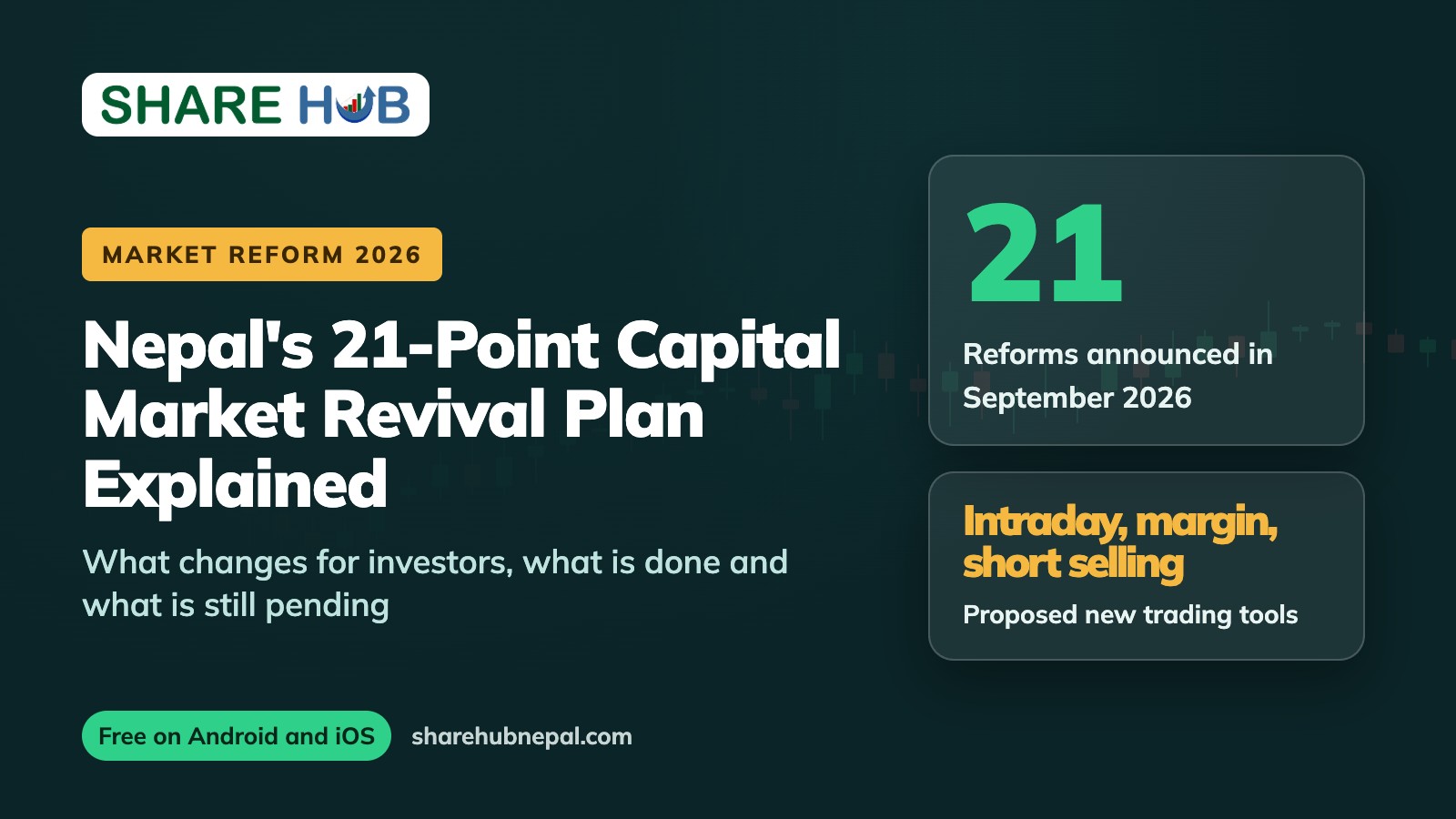
In mid-September 2026, with NEPSE under pressure and investor confidence fading, the Ministry of Finance released the Capital Market Strengthening and Revival Action Plan, 2083. It is the broadest set of capital market reforms Nepal has announced in years. It touches everything from how IPOs are priced to whether you will one day be able to buy and sell the same stock on the same day.
Policy announcements are easy to cheer and hard to follow through. This guide groups the plan into the parts that matter most to ordinary investors, and separates what has already happened from what is still on paper.
Status as of late October 2026: the capital gains tax cut is in effect. Intraday trading is at the consultation stage. Most other measures carry deadlines between mid-October 2026 and mid-March 2027 and still need laws, rules or systems before they reach investors.
1. Lower capital gains tax, already in effect
The change investors felt first was tax. Capital gains tax for resident individuals on listed securities was cut to 3.75% for shares held more than 365 days and 5% for 365 days or less. The rates took effect on 22 September 2026 after publication in the Nepal Gazette, reversing the increase made in the budget earlier in the year.
The plan also proposes netting profits and losses through the trading and settlement system, so that tax is charged only on your net gain. That piece is not yet in place. Our capital gains tax guide covers the details with worked examples.
2. New ways to trade: intraday, margin and short selling
The plan calls for updates to the Securities Act covering margin lending, intraday trading, securities lending and borrowing, and short selling, along with a modernised share-buying system and margin trading through licensed brokers.
- Intraday trading: SEBON has published a concept paper proposing a phased rollout. The first phase would allow "buy first, sell later" on the same day for a limited set of liquid stocks. Selling first and buying later would come only after securities lending and covered short selling are in place. It is still at the consultation stage.
- Margin lending: the plan targets broker-led margin trading by mid-January 2027, alongside rules approved by the finance ministry.
- Short selling and securities lending: these need legal changes first, so expect them later than intraday trading.
Leverage cuts both ways. Before using margin, it is worth understanding the risks. This ShareHub video explains margin trading and share loans in Nepal:
3. IPO reform and better price discovery
- SEBON is to issue guidelines setting basic IPO eligibility requirements immediately.
- Sector-specific IPO rules for hydropower, manufacturing, hotels and tourism, agriculture and pharmaceuticals, covering eligibility, price discovery and allocation, are due by mid-January 2027.
- Companies would be able to buy back shares from retained earnings and to consolidate or split shares, targeted for mid-February 2027.
4. A restructured NEPSE and a new benchmark index
The plan calls for restructuring NEPSE based on earlier task force recommendations and for introducing a new benchmark index by mid-December 2026, while keeping the existing all-equity NEPSE index. A review of CDS and Clearing Limited's structure and capacity is due by mid-March 2027.
5. Opening the door to non-resident Nepalis
Amendments to the foreign investment and foreign exchange laws, aimed at letting non-resident Nepalis trade in the secondary market, were scheduled to go to the Cabinet by mid-October 2026. New NRN securities rules took effect in early October, but general secondary market access is not yet available. Our guide on whether NRNs can invest in the Nepal stock market explains where things stand.
6. Bigger role for institutions, bonds and mutual funds
- A mutual fund and bond market development policy, with rules and infrastructure due by mid-December 2026.
- An active secondary market for Treasury bills and development bonds, including a review of trading fees.
- Encouraging the Employees Provident Fund, Citizen Investment Trust, Social Security Fund, insurers and mutual funds to invest more in the market.
- A joint SEBON and Nepal Rastra Bank review of investment limits, risk weights and collateral rules for banks, due by mid-November 2026.
- Policies encouraging green, social, disaster and project-specific bonds.
What it means for you as an investor
- Your tax bill is already lower. Long-term holders benefit most.
- Trading tools are coming, slowly. Intraday and margin trading will change market behaviour, but not overnight. Watch for SEBON and NEPSE directives.
- More institutional money could support liquidity. If pension funds and insurers invest more, the market could become deeper and less dependent on retail sentiment.
- Policy headlines move prices, delivery moves markets. The index rose about 48 points the day after the plan was announced. Lasting effects will depend on implementation.
Reform tracker
| Measure | Target | Status (late October 2026) |
|---|---|---|
| CGT cut to 3.75% and 5% | Immediate | In effect from 22 September 2026 |
| Loss netting for CGT | Not specified | Proposed |
| Intraday trading | Rules by mid-October 2026 | Concept paper under consultation |
| Margin trading through brokers | Mid-January 2027 | Pending |
| New NEPSE benchmark index | Mid-December 2026 | Pending |
| NRN secondary market access | Law changes by mid-October 2026 | Pending |
| Buybacks and share splits | Mid-February 2027 | Pending |
| CDS and Clearing review | Mid-March 2027 | Pending |
We will update this tracker as measures are implemented.
Also in the app: Market news, live NEPSE data and price alerts is available in the ShareHub mobile app for Android and iOS, so you can do it from your phone as easily as from your computer.
Frequently asked questions
What is the 21-point capital market plan?
It is the Capital Market Strengthening and Revival Action Plan, 2083, released by Nepal's Ministry of Finance in September 2026 to revive the stock market through tax, regulatory and market infrastructure reforms.
Is intraday trading allowed in Nepal now?
Not yet. SEBON has proposed a phased rollout starting with "buy first, sell later" for selected liquid stocks, and the proposal is still under consultation.
When will the new NEPSE index launch?
The plan targets mid-December 2026. The existing NEPSE index will continue alongside it.
Stay ahead of every policy change
Follow NEPSE news, live market data and alerts in ShareHub, free on web and mobile.
Read market newsGet it on Google PlayDownload on the App Store