
The Real Cost of Buying and Selling Shares in Nepal: Commission, SEBON Fee, DP Charge and Break-Even

Share Hub
October 23, 2026 03:38 AM
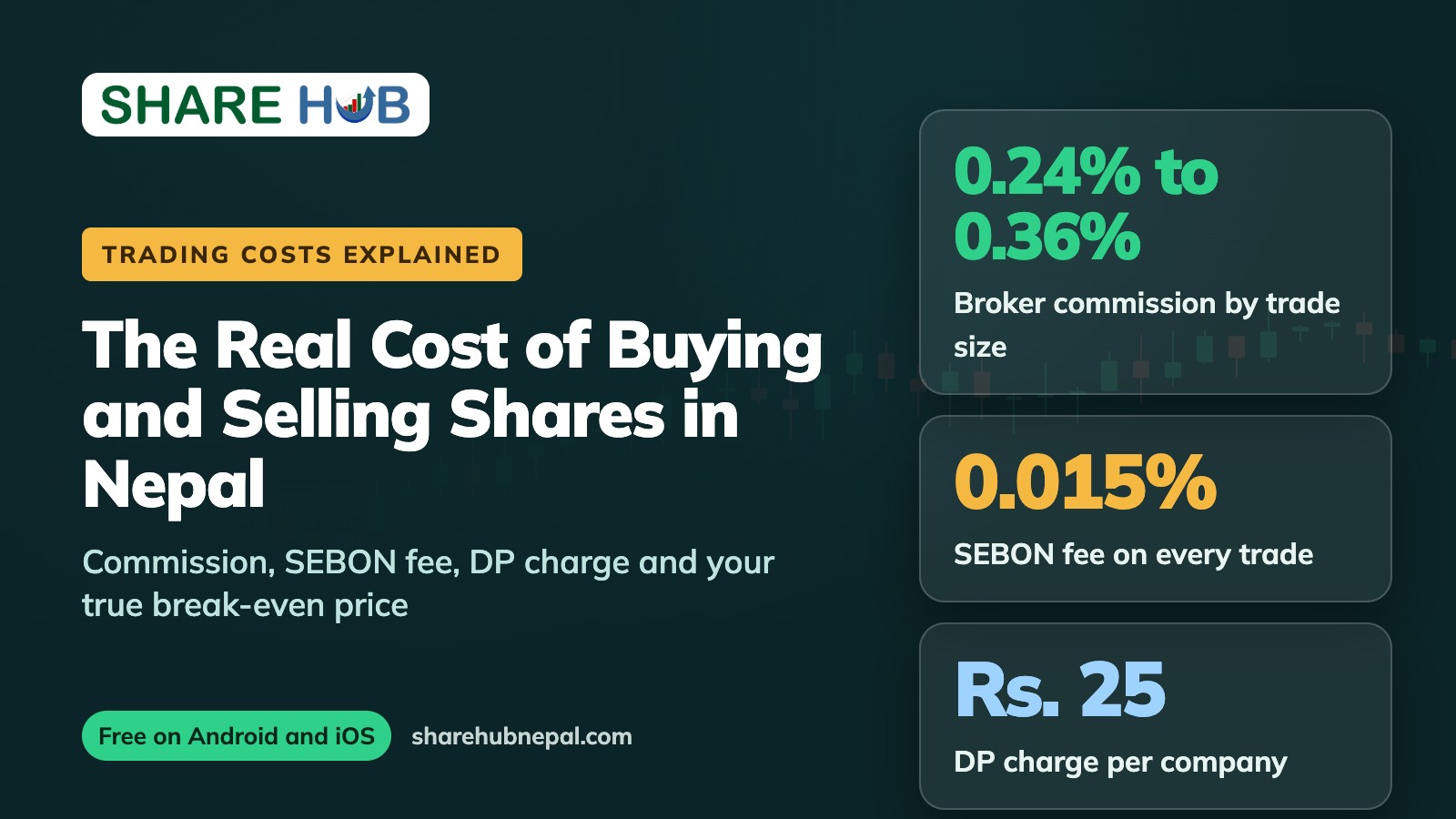
Most new investors in Nepal think about two numbers: the price they buy at and the price they sell at. The difference looks like profit. In reality, every trade passes through four or five charges before the money reaches your bank account, and on small trades those charges can quietly erase a good part of your gain.
This guide breaks down every cost involved in buying and selling shares on NEPSE, shows how much they add up to on real trades, and explains how to work out the price a stock must reach before you are actually in profit.
The four costs on every NEPSE trade
- Broker commission: a percentage of the trade value, charged on both buying and selling.
- SEBON fee: 0.015% of the trade value, charged on both buying and selling.
- DP charge: a flat Rs. 25 per company per transaction day, paid to your depository participant.
- Capital gains tax: charged only when you sell at a profit. The current rates are 3.75% for shares held more than 365 days and 5% for 365 days or less. Our CGT guide explains how it works.
Broker commission rates for equity shares
Broker commission is set by slabs. The larger the trade, the lower the percentage:
| Trade value | Broker commission |
|---|---|
| Up to Rs. 50,000 | 0.36% (minimum Rs. 10) |
| Rs. 50,001 to Rs. 5,00,000 | 0.33% |
| Rs. 5,00,001 to Rs. 20,00,000 | 0.31% |
| Rs. 20,00,001 to Rs. 1,00,00,000 | 0.27% |
| Above Rs. 1,00,00,000 | 0.24% |
These are the rates ShareHub's calculators apply. Commission is charged separately on the buy and on the sell, so a round trip roughly doubles it.
A slab quirk worth knowing: a Rs. 50,000 purchase pays Rs. 180 in commission at 0.36%, while a Rs. 50,001 purchase pays about Rs. 165 at 0.33%. Because the lower rate applies to the whole amount, trades just above a slab boundary can cost less than trades just below it.
What a trade really costs: two examples
Example 1: a small purchase
You buy 100 shares at Rs. 500, a trade value of Rs. 50,000.
| Charge | Amount (Rs.) |
|---|---|
| Share value | 50,000.00 |
| Broker commission (0.36%) | 180.00 |
| SEBON fee (0.015%) | 7.50 |
| DP charge | 25.00 |
| Total payable | 50,212.50 |
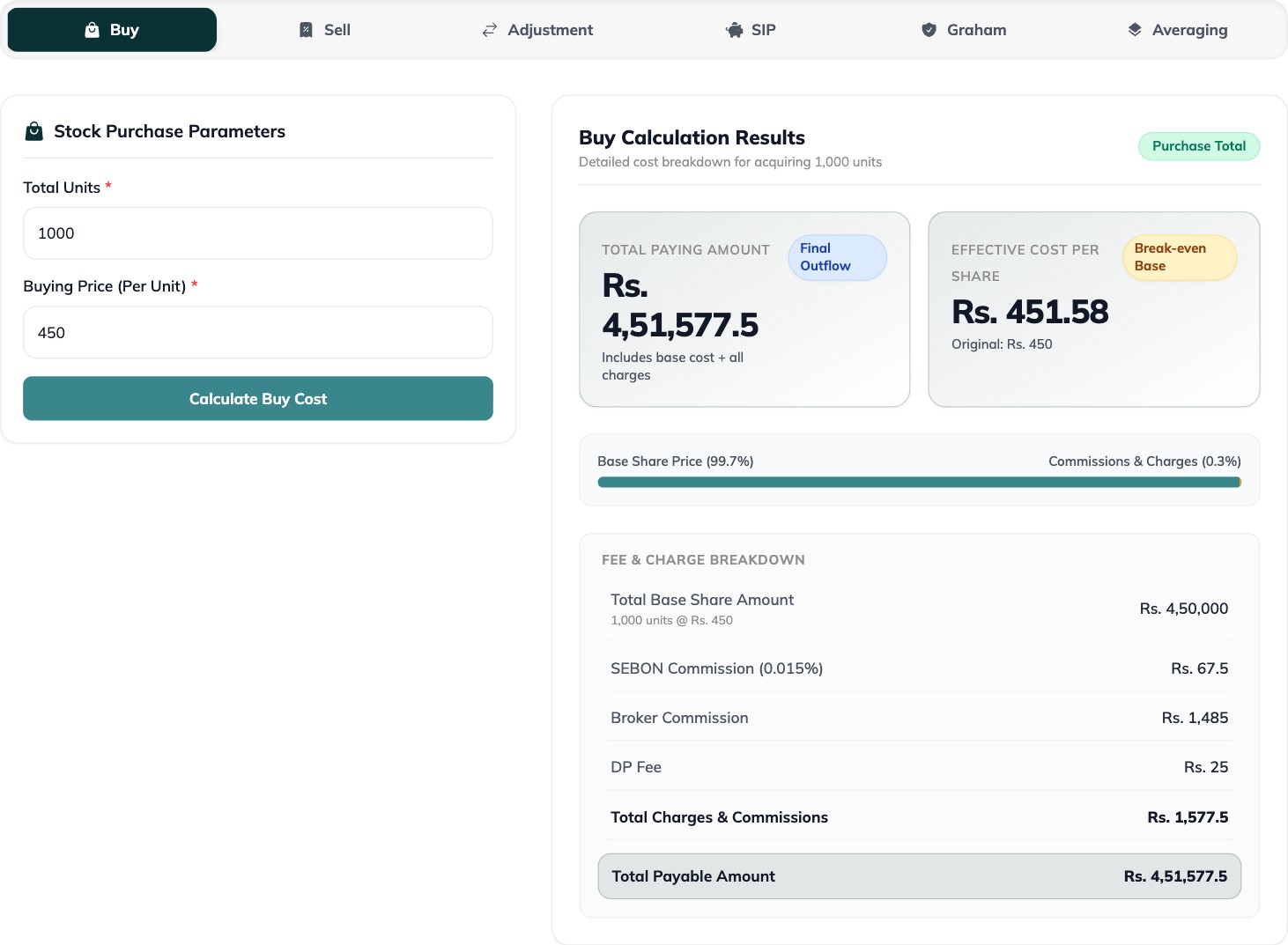
Your effective cost per share is Rs. 502.13, not Rs. 500. Charges add about 0.43% before the price has moved at all.
Example 2: a larger purchase
You buy 1,000 shares at Rs. 450, a trade value of Rs. 4,50,000. Commission drops to 0.33%, so you pay Rs. 1,485 in commission and Rs. 67.50 as the SEBON fee.
How to find your break-even price
Your break-even price is the selling price at which you get back exactly what you paid, after all charges on both sides. Below it, you lose money even if the price is above what you bought at.
Take Example 2. Your total purchase cost is Rs. 4,51,552.50. When you sell, you pay about 0.345% in commission and SEBON fee plus a Rs. 25 DP charge. Working backwards, you need to sell for roughly Rs. 4,53,141, or about Rs. 453.14 per share. The stock has to rise about 0.7% just for you to stand still. Capital gains tax applies only to profit beyond that point.
For small trades the hurdle is higher, because the minimum charges and the flat DP charge weigh more heavily. This is the main reason frequent small trades tend to underperform.
Putting it together: a full round trip
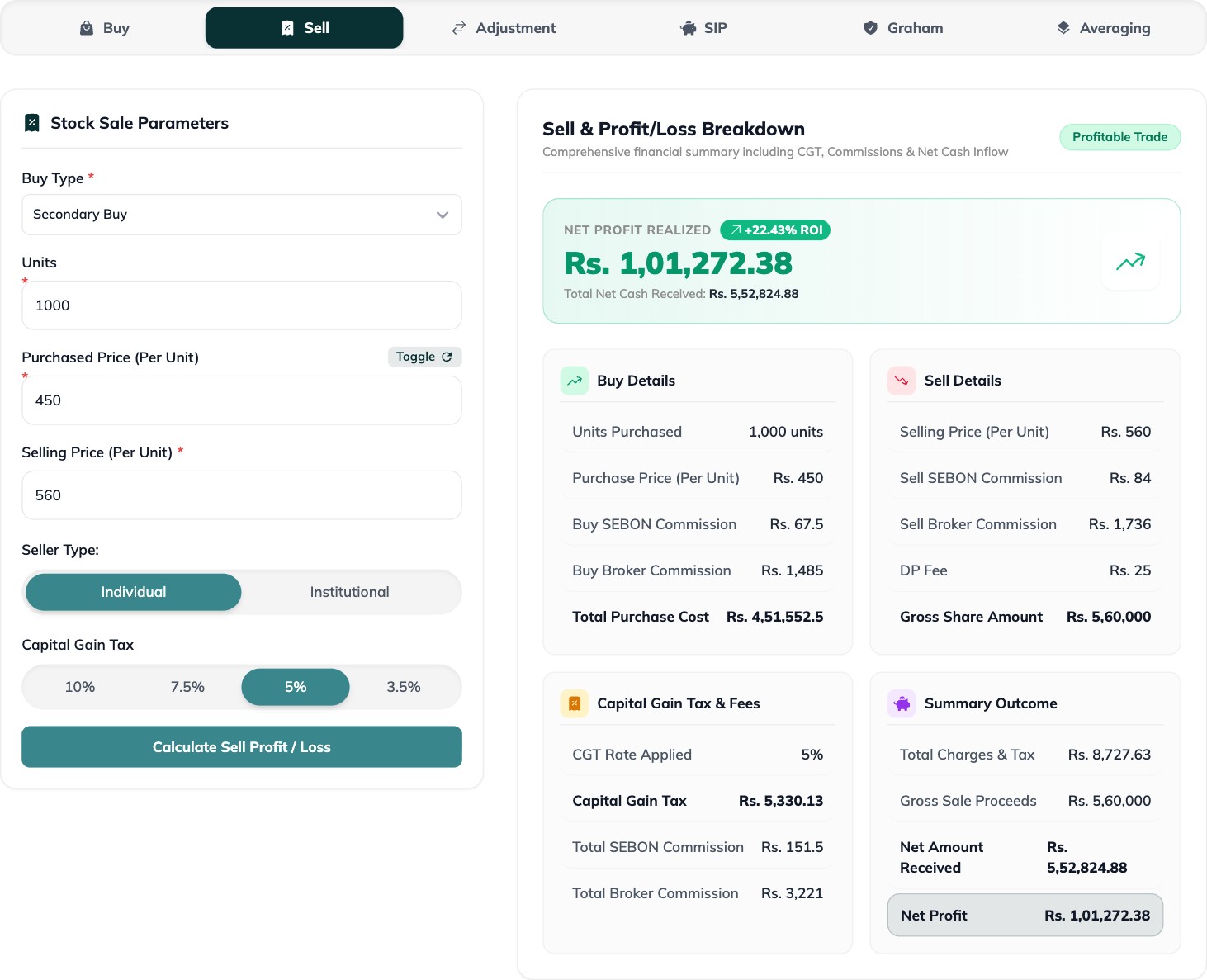
Using ShareHub's Sell calculator, here is the full picture for buying 1,000 shares at Rs. 450 and selling them at Rs. 560 within a year:
| Item | Amount (Rs.) |
|---|---|
| Total purchase cost | 4,51,552.50 |
| Gross sale value | 5,60,000.00 |
| Sell commission, SEBON fee and DP charge | 1,845.00 |
| Capital gains tax at 5% | 5,330.13 |
| Net amount received | 5,52,824.88 |
| Net profit | 1,01,272.38 |
Charges and tax together come to Rs. 8,727.63, about 8% of the gross profit. Holding past 365 days would have reduced the tax to 3.75%.
See the buying and selling process in action
If you are still getting comfortable with placing orders, this video from the ShareHub NEPSE Beginner Series walks through the buy and sell process in TMS:
How to keep trading costs low
- Trade less, trade bigger. Fewer, larger trades pay lower commission rates and fewer DP charges.
- Mind the slab boundaries. If you are close to Rs. 50,000 or Rs. 5,00,000, a slightly larger order can reduce the commission rate.
- Sell in one day where possible. The DP charge applies per company per transaction day, so splitting a sale across days adds charges.
- Know your break-even before you buy. If your target is only 1% away, costs will take a meaningful share of the profit.
- Hold winners longer when it makes sense. Crossing 365 days cuts CGT from 5% to 3.75%.
Also in the app: The Buy and Sell calculators is available in the ShareHub mobile app for Android and iOS, so you can do it from your phone as easily as from your computer.
Frequently asked questions
How much is broker commission in Nepal?
Between 0.24% and 0.36% of the trade value depending on trade size, with a minimum of Rs. 10, charged on both buy and sell.
What is the SEBON fee?
0.015% of the trade value, charged on both buy and sell.
What is the DP charge?
Rs. 25 per company per transaction day, paid to your depository participant.
Is capital gains tax charged on every sale?
Only on profitable sales. It is charged on the gain after deducting your purchase cost and sale charges.
Know your numbers before every trade
Use the free ShareHub calculators to see total cost, break-even and net profit in seconds.
Try the calculatorsGet it on Google PlayDownload on the App Store