













Himalayan Laghubitta Bittiya Sanstha Limited – First Quarter Analysis, FY 2083/84
Unaudited results as on Ashwin end 2083, compared with the same quarter last year (Ashwin end 2082) and with the year end (Ashad end 2083).
Summary
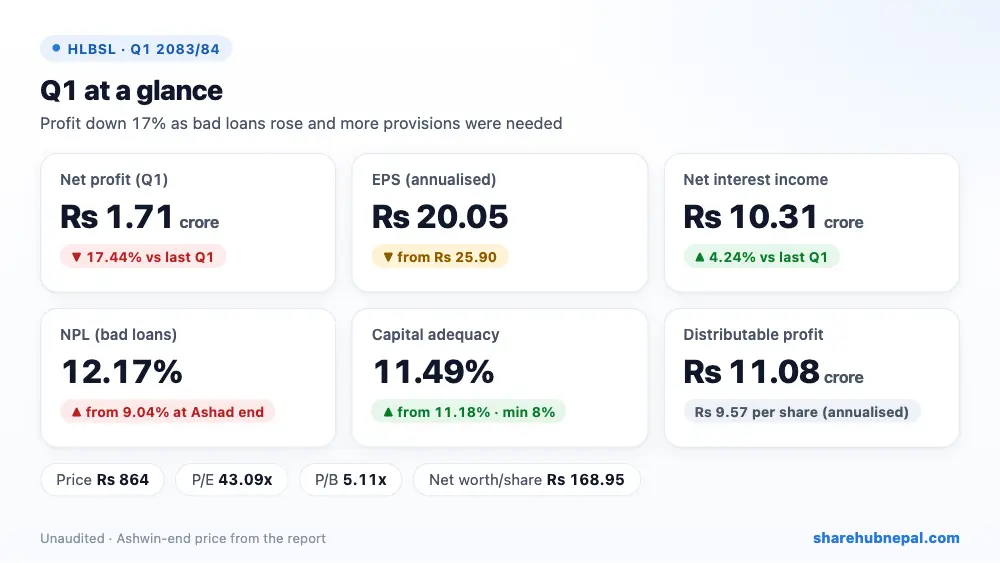
Himalayan Laghubitta earned a net profit of Rs 1.71 crore in the first quarter, down 17.44% from Rs 2.07 crore in the same quarter last year. EPS is Rs 20.05 against Rs 25.90.
Compared with last year, the biggest help came from net interest income (+Rs 41.91 lakh) and fees & commission (+Rs 17.62 lakh), while the biggest drag was impairment (−Rs 58.23 lakh).
Himalayan Laghubitta, a subsidiary of Himalayan Bank, earned Rs 1.71 crore in Q1, down 17.44% from Rs 2.07 crore. Net interest income rose 4.24% to Rs 10.31 crore because funding got cheaper (cost of funds 5.19% from 6.21%), and fee income rose 18.00%. But bad loans pushed loan-loss charges up 41.80% to Rs 1.98 crore and staff costs rose 11.56%. Management blames the anti-microfinance movement, which encouraged some borrowers not to repay, plus weak remittances.
| Indicator | Q1 2083/84 | Q1 2082/83 | Change |
| Net profit | Rs 17,096,452 | Rs 20,708,175 | −17.44% |
| Net interest income | Rs 103,060,503 | Rs 98,869,041 | +4.24% |
| Net fee and commission income | Rs 11,546,561 | Rs 9,785,044 | +18.00% |
| Impairment charge/(reversal) | Rs 19,753,633 | Rs 13,930,740 | +41.80% |
| Operating profit | Rs 24,423,503 | Rs 29,548,145 | −17.34% |
| EPS | Rs 20.05 | Rs 25.90 | – |
| Net worth per share | Rs 168.95 | Rs 162.52 | +3.96% |
| NPL | 12.17% | 6.95% | +5.22 pts |
| Capital adequacy | 11.49% | 9.53% | +1.96 pts |
1. Where the profit came from
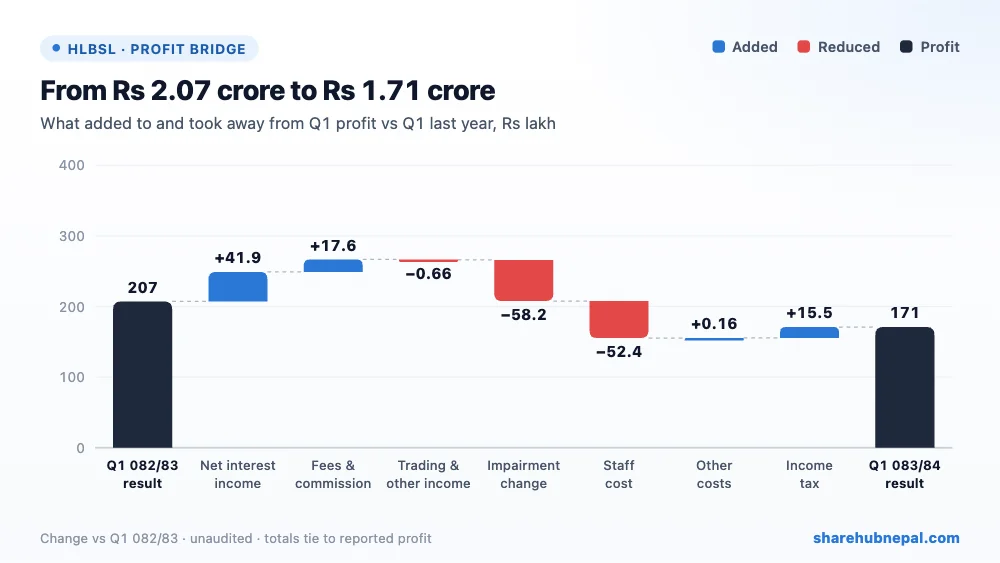
The bridge chart shows how Q1 profit moved from last year's Rs 2.07 crore to this year's Rs 1.71 crore:
- Impairment (−Rs 58.23 lakh): the bank set aside Rs 1.98 crore for loan losses, against Rs 1.39 crore last year.
- Staff cost (−Rs 52.40 lakh): personnel expenses rose 11.56% to Rs 5.06 crore.
- Net interest income (+Rs 41.91 lakh): interest income fell 3.87% while interest expense fell 14.84%.
- Fees & commission (+Rs 17.62 lakh): net fee income was Rs 1.15 crore against Rs 97.85 lakh.
- Income tax (+Rs 15.48 lakh): tax was Rs 73.27 lakh against Rs 88.75 lakh last year.
- Trading & other income (−Rs 65,547): trading income and other operating income combined.
- Other costs (+Rs 16,232): other operating expenses, depreciation and non-operating items combined.
In plain terms: operating costs took 61.6% of operating income, against 60.1% a year ago. Impairment took 17.2% of operating income.
2. Profit through the year
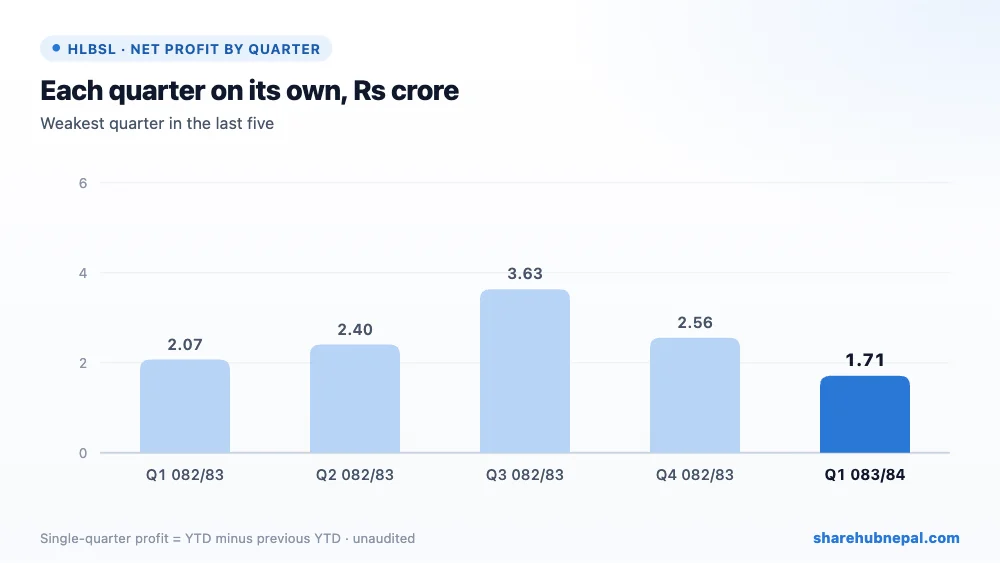
Looking at each quarter on its own (year-to-date profit minus the previous quarter's): Q1 082/83: Rs 2.07 crore; Q2 082/83: Rs 2.40 crore; Q3 082/83: Rs 3.63 crore; Q4 082/83: Rs 2.56 crore; Q1 083/84: Rs 1.71 crore.
Based on Share Hub records, single-quarter profit in 2082/83 was Rs 2.07 crore in Q1, Rs 2.40 crore in Q2, Rs 3.63 crore in Q3 and Rs 2.56 crore in Q4. This Q1 is the weakest of the last five quarters.
3. Deposits, loans and liquidity
| Particulars | Ashwin 2083 | Ashad 2083 | Change |
| Deposits from customers | Rs 1,276,391,158 | Rs 1,272,164,229 | +0.33% |
| Loans and advances to customers | Rs 5,021,688,398 | Rs 4,962,718,639 | +1.19% |
| Cash and cash equivalent | Rs 470,146,049 | Rs 1,037,414,608 | −54.68% |
| Balance with Nepal Rastra Bank | Rs 26,000,000 | Rs 26,000,000 | +0.00% |
| Investment securities | Rs 1,200,000 | Rs 1,200,000 | +0.00% |
| Total assets | Rs 5,657,369,520 | Rs 6,146,982,707 | −7.97% |
| Total equity | Rs 576,267,445 | Rs 554,317,289 | +3.96% |
In the quarter, deposits grew 0.33% and customer loans grew 1.19%. The credit-to-deposit ratio is 105.77% (97.55% a year ago).
Pricing: cost of funds 5.19% (from 6.21%), base rate 11.59% (from 11.99%), interest spread 9.15% (from 8.75%).
Loans grew 1.19% to Rs 5.02 arba and deposits were flat at Rs 1.28 arba. The company used Rs 56.73 crore of its cash to repay borrowing, which fell 13.40% to Rs 3.47 arba (most of it from Himalayan Bank). Loans are 105.77% of deposits plus borrowing.
4. Bad loans and capital
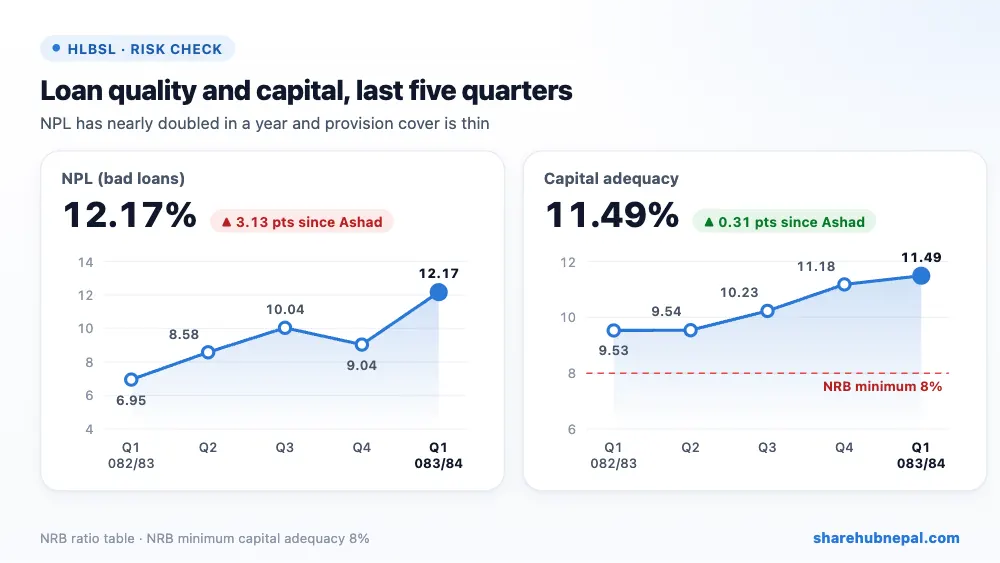
- NPL is 12.17%, against 9.04% at Ashad end and 6.95% a year ago. Loan-loss provisions cover 30.43% of bad loans (37.37% a year ago).
- Capital adequacy is 11.49%, against 11.18% at Ashad end and 9.53% a year ago. NRB's minimum is 8%, so the buffer is 3.49 points.
- Asset quality is weakening fast. NPL rose to 12.17% from 9.04% at Ashad end and 6.95% a year ago, and provisions cover only 30.43% of bad loans, so more provisions are likely. Capital adequacy improved to 11.49%, comfortably above the 8% minimum.
5. Distributable profit
| Particulars (Rs) | Amount |
| Net profit for the quarter | 17,096,452 |
| Less: general reserve | (3,419,290) |
| Less: CSR and client protection funds | (683,859) |
| Less: interest receivable (regulatory) | (4,828,565) |
| Q1 distributable profit | 8,164,739 |
| Opening retained earnings | 102,622,803 |
| Distributable profit at Ashwin end | 110,787,542 |
Of the Rs 1.71 crore profit, Rs 81.65 lakh is distributable after Rs 41.03 lakh of required funds and Rs 48.29 lakh of interest receivable that cannot be distributed. Distributable profit is now Rs 11.08 crore.
6. Per-share figures and valuation
| Indicator | Value |
| EPS (as reported) | Rs 20.05 |
| Net worth per share | Rs 168.95 |
| Distributable EPS | Rs 9.57 |
| Closing price, Ashwin end 2083 | Rs 864.00 |
| Price range during the quarter | Rs 835.00 – Rs 914.00 |
| P/E (annualised EPS) | 43.1x |
| Price to book | 5.11x |
At Rs 864 the share trades at 43.09 times annualised EPS and 5.11 times net worth per share, which is expensive for a falling profit and rising bad loans.
Conclusion
Positives: cheaper funding, higher net interest and fee income, stronger capital (11.49%), backing of Himalayan Bank.
Watch points: NPL at 12.17% with only 30% cover, rising provisions and staff costs, slow loan growth and a high P/E.
Core income is holding up, but bad loans are the problem. Profit will stay under pressure until collections improve.
Based on the company's unaudited first-quarter report. Figures may change after audit or regulator review. This is not investment advice.